Slopes, drainage edges, terraces and tree-filled plots create a basic access problem: a machine that cuts well on open ground may be difficult or unsafe to position there. By the end, you will know how the backpack layout changes weight distribution, how to work without losing balance, which attachment fits the vegetation and what to verify before choosing a model.
Key takeaways
- Carry power across slopes, steps and narrow gaps that wheels cannot reach.
- Use a blade for woody stems and a trimmer head for grass.
- Keep the cutter uphill, maintain stable footing and clear your escape path.
- Compare engine weight, harness adjustment and local service before buying.
Why the backpack layout reaches ground that wheels cannot
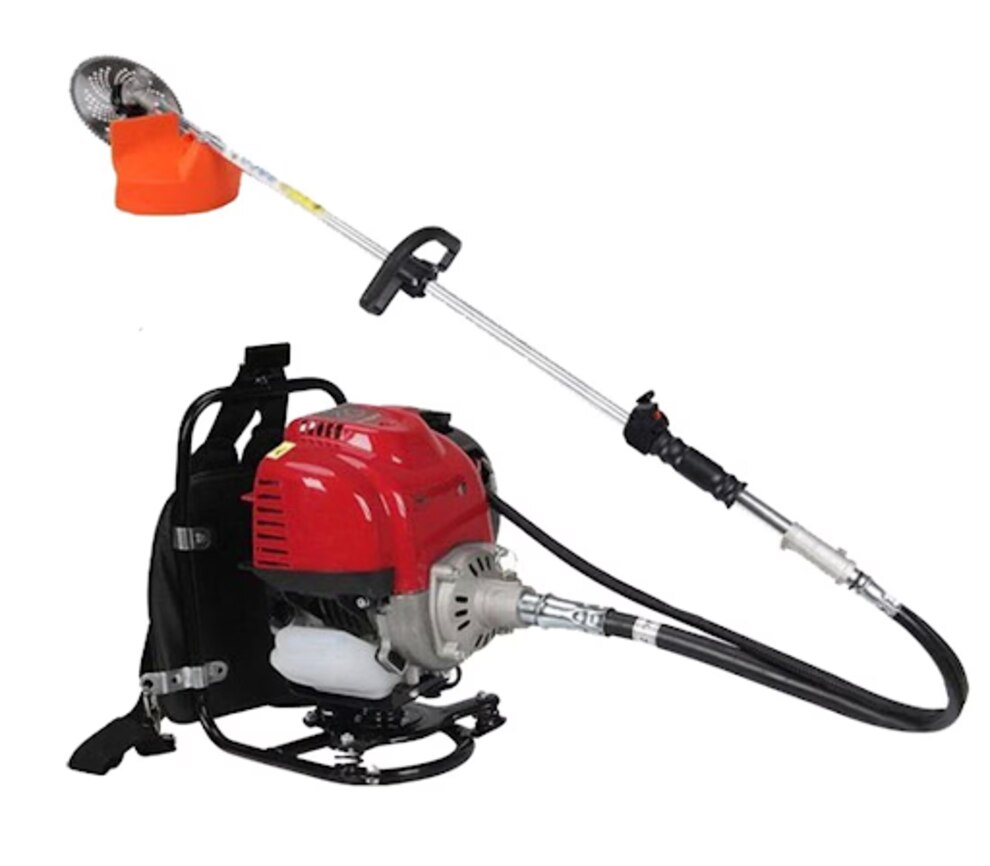
A backpack brush cutter reaches ground that wheels cannot because it separates the engine from the cutting head. You can carry the power unit over uneven terrain while guiding the head around obstacles, through narrow gaps and beneath low branches.
- The backpack frame keeps the engine supported against your back instead of forcing wheels to stay level on the ground.
- Shoulder straps spread the load across your shoulders and torso, leaving both hands available to control the handle and cutting arc.
- The flexible drive shaft lets you position the head independently of the engine, so you can work beside tree trunks, fence lines, drainage edges and embankments.
The layout changes the burden; it does not remove it. The engine still adds its full mass to your body, and the frame can increase heat retention around your back during long sessions.
A flexible drive shaft also has a minimum bend radius: kink it around a corner and power transmission suffers, while the cable, tube and bearings face faster wear. Follow the specified lubrication schedule.
Keep the shaft in a smooth curve and carry the head below waist height. The independent cutting head improves access, but it does not make hidden wire, stones, roots or irrigation pipes harmless. On a slope, stable footing and a controlled sideways cutting path matter more than the machine’s ability to reach the vegetation.
Where a backpack brush cutter has a practical access advantage
The access advantage matters most where wheels cannot travel efficiently. A backpack machine keeps the bulky power unit away from the cutting head, so you can place the head around obstacles, carry it across broken ground and clear small, disconnected patches without repeatedly repositioning a mower.
- On steep slopes, the operator can work across the face rather than forcing a wheeled machine up or down it.
- Across terraces, the machine crosses narrow steps, banks and irregular edges where a wheel may lose traction or cannot turn.
- Over uneven ground and rocky ground, the cutting head can follow gaps between stones and roots without the chassis striking them.
- Along drainage edges and embankments, the flexible shaft reaches below the shoulder line and around the channel without placing wheels at the drop-off.
- Along fence lines, it reaches under wire and close to posts without pushing a deck into the fence.
- Between trees or structures, it fits through narrow openings and lets you cut around trunks, walls and posts.
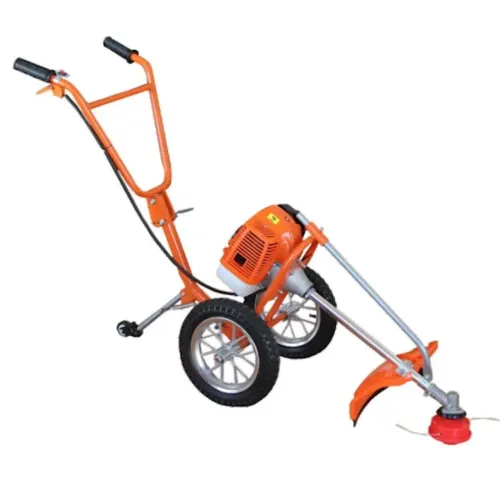
A wheel brush cutter becomes more productive when the area is open, level, broad and covered with uniform vegetation. It rolls its cutting mechanism over a predictable path, reducing the carrying burden and covering more ground per pass.
| Option | Access and productivity | Better choice |
|---|---|---|
| Backpack brush cutter | Obstacles, slopes, terraces and fragmented patches; slower over large open areas | Restricted or irregular ground |
| Wheel brush cutter | Fast, consistent passes on firm, level ground; poor access near drops and obstacles | Broad, continuous vegetation clearance |
How to cut on a slope without turning access into a safety risk
A stable traverse is safer than climbing straight up or down a steep face. Keep both feet on firm ground, place them shoulder-width apart with one slightly ahead, bend your knees, and keep your weight over your feet rather than leaning into the slope. Never let a slip carry your body toward the cutting head.
1. Walk the proposed strip before starting. Remove loose stones and mark roots, irrigation pipes, fence posts and visible wire; if you cannot see what lies in dense vegetation, do not attack it with a blade. Hidden wire can wrap the head, break into thrown objects or cause kickback.
2. Set the cutting head below waist height and keep it level with a controlled side-to-side arc. On inspected grass, hold the head about 5 to 10 centimetres above the soil; raise it over rough ground, roots or suspected pipes.
Do not use the head to scrape soil, which can expose stones and damage line or blades.
3. Move across the slope in short passes, keeping the machine on the uphill side of your body where practical. Stop, reposition your feet and maintain a straight flexible shaft; do not overreach or sharply kink it.
4. Keep people, animals and fragile property outside the thrown-objects zone. Wear eye and hearing protection, long trousers and sturdy boots, and fit the correct guard before cutting near fencing or hard surfaces. If the head strikes stone, wire or metal, release the throttle, stop the engine and inspect it before continuing.
This routine is slope safety, not a substitute for refusing unstable footing.
Match the attachment and machine style to the vegetation
Use nylon line for grass and light herbaceous growth, a brush knife for dense weeds, reeds and thorny scrub, and a saw blade for woody stems within the machine’s approved diameter range.
A metal attachment is not a universal upgrade: the wrong guard, arbor hardware or blade rating can cause imbalance, ejection or a stalled cutter.
- Grass: Nylon line gives controlled trimming around posts, trees and uneven edges, but it wears quickly against stone and concrete.
- Dense weeds: A heavy nylon line or brush knife handles thicker stems; stop if the head repeatedly bogs down.
- Reeds: A brush knife cuts standing reed clumps cleanly; line can wrap around wet, fibrous growth.
- Thorny scrub: Use a brush knife when stems remain within the manufacturer’s limit, and keep the guard fitted.
- Woody stems: Use a saw blade only for the stated stem diameter. Oversized stems can stall the blade, overload the clutch or gearbox and kick the machine sideways.
Backpack and conventional handheld cutters differ in how they carry the same cutting work:
| Option | Reach | Control | Fatigue | Manoeuvrability |
|---|---|---|---|---|
| Backpack model | Flexible shaft reaches beneath branches and into narrow gaps | Cutting head feels lighter, but shaft reaction still needs active control | Less arm load; more back weight and heat around the torso | Better for fragmented, obstructed ground |
| Handheld cutter | Direct shaft suits open, close-position work | Immediate feedback through both hands | More arm and shoulder fatigue over long sessions | Quicker for short repositioning and precise trimming |
Neither format makes hidden wire, fencing or stones safe to contact. Inspect the path before cutting.
Compare engines, harnesses and service requirements before buying
A 9.5 kg power unit is already a substantial back load before fuel, harness, shaft and cutting attachment are added. Test the harness adjustment with work clothing on: the frame must sit close to your back, the shoulder straps must not carry all the weight, and the hip support must not restrict movement.
| Option | What to verify | Practical consequence |
|---|---|---|
| 2-stroke | Correct fuel-to-oil ratio, fresh mixed fuel and approved storage container | More fuel preparation; an incorrect mix can damage the engine |
| 4-stroke | Straight petrol requirement, oil level and oil-change interval | Simpler refuelling, but engine oil becomes another service item |
| Either engine | Torque response in dense weeds, noise, declared hand-arm vibration and throttle control | A higher power figure does not guarantee easier cutting or lower exposure |
| Either engine | Tank capacity, refuelling access and hot-engine refuelling procedure | Smaller tanks mean more stops; never refuel beside a hot muffler |
| Either engine | Attachment rating, drive direction, shaft length and compatible blade or line head | An incompatible attachment can overload the clutch, shaft or gearbox |
Treat vibration figures as exposure-planning data, not a full-shift prediction. Attachment balance, cutting resistance, grip force, throttle use and shaft condition change hand-arm vibration; the EU action value is 2.5 m/s² A(8), with a 5 m/s² A(8) exposure limit.
Ask Importers of Agricultural Equipments for the service schedule, flexible-shaft lubrication specification and parts availability. Include drive-cable, clutch, gearbox and cutting-head bearing checks, especially for abrasive vegetation; sharp bends, contamination and overheating shorten service life.
Related products
 | GASOLINE BRUSH CUTTER SAM 2 Stroke Backpack Brush Cutter Engine Type: Air Cooled, 2 Stroke Engine Power: 1.4kw/1.9HP Engine Displacement: 51.7cc Fuel Tank Capacity: 1.1Ltr Weight:9.5kg View product → |
 | GASOLINE BRUSH CUTTER SAM-CGX-35 4 Stroke Backpack Brush Cutter Engine Type: Air Cooled, 4 Stroke Engine Power: 0.8kw / 1.3HP Engine Displacement: 35.8cc Fuel Tank Capacity: 0.8Ltr Weight: 9.5kg View product → |
Frequently asked questions
Why does a backpack brush cutter reach areas that wheeled machines cannot?
The engine sits on your back while a flexible shaft lets you guide the cutting head around obstacles, through narrow gaps and beneath branches.
Where is a backpack brush cutter useful?
Use it on steep slopes, rocky ground, terraces, drainage edges, fence lines, orchards and confined spaces where wheels lose access.
How can you use one safely on a slope?
Work across the slope rather than directly downhill, keep stable footing, avoid wet ground and maintain a clear escape route.
Which attachment suits different vegetation?
Choose a nylon line head for grass and soft weeds, a metal blade for tougher weeds, and a brush blade for woody stems within the machine's rating.
What should you compare before buying a backpack brush cutter?
Compare engine output, total carried weight, harness support, shaft control, attachment compatibility, spare parts availability and service access.